

It’s summer time and during my summer months of slumber, I love to catch up on reading. “Mathematics for Human Flourishing” has been on my bookshelf for a big. Thanks to a conversation with my buddy, Pam Brett (blueglassesmath.com).…I was intrigued to read it.
I have listened to Francis Su on a podcast and wrote a blog post about it. I have admired his simplistic approach to appreciating math of all kinds. I have to admit that one of the reasons I held off on this book was because I’ve only gone so far as to taken a pre-calculus course which I received a D in. I had a fear that I’d be reading about much higher math than what’s in my wheelhouse. Instead Dr. Su says, “this is a book that grounds mathematics in what it means to be a human being and to live a more fully human life.”
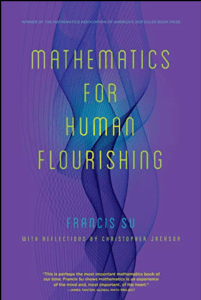
Dr. Su explains that “to do mathematics means more than learning facts of mathematics–it means seeing oneself as a capable mathematics learner who has the confidence and the habits of mind to tackle new problems.” And why should do mathematics? Mathematics helps people flourish (whether you may be aware or not).
Human flourishing is broken down to human virtues such as exploration, meaning, play, beauty, permanence, truth, struggle, power, justice, freedom, and love. There are so many nuggets of inspiration in this book that I literally had a notebook next to me and took notes for each chapter. It’s not that I was going to be taking an exam on his book anytime soon. It was the fact that he articulated humanity – our needs, our virtues, our desires – into a math story that anyone of us can enjoy. My experience of studying his words was thought provoking and I wanted to remember every sentence and phrase that resonated with me. It turns out there was TOO many ideas that resonated with me.
Here are my favorites:
- Mathematical ideas is like space exploration, but a space of ideas in which you are captivated by mystery, motivated by questions, and undeterred by setbacks.
- Math is the science of patterns and the art of engaging the meaning of those patterns.
- Math play builds hopefulness—when you tinker with a problem long enough…you hope to solve it.
- Math play also builds confidence in struggle, patience, perseverance, ability to change perspective and an openness of spirit.
- We would teach math so differently if we thought of it as a playful sport…not a performance sport.
- Productive struggle describes the state of actively wrestling with a problem, persistently trying out various strategies, being willing to take risks, being unafraid of mistakes and progressing incrementally in understanding the underlying ideas.
- Teachers possess power to create conditions that can help students learn a great deal of keep them from learning much at all. Teaching is the intentional act of creating those conditions and good teaching requires that we understand the inner sources of both the intent and the act.
- Grades are a measure of progress but not a measure of promise.
- To love through and because of mathematics is to build hopefulness, to cultivate creativity, to promote reflection, to foster a thirst of deep knowledge and deep investigation, to encourage in ourselves and one another a disposition toward beauty and all the other virtues.
- To love and be loved is the supreme mark of human flourishing.
This book has given me a renewed spirit in my journey as a mathematics educator. Thank you Dr. Su.
Until next time,
Kristen