

Recently NCTM published an article on Clothesline Math. I knew this was in the pipeline because one of the authors reached out to me asking my permission to use some of my images. I agreed and sent the author a copy of my book, “Hanging Math Out to Dry Using Clothesline Math.” This was done for free out of the kindness of my heart. I figured that if the authors could use another source, then so be it. All I asked in return was to see an advanced copy of the article and to give me credit (where credit was due). I never did receive an advance copy of the article. I didn’t even receive a “Thank You” for the book.
I liked….
- The article focused on Pre-K- 3rd grade specifically. I like to heavily focus on these grades during my own presentations because these are the grades that are the building blocks to big math ideas. Sometimes these grade levels don’t get enough attention.
- Using and adapting number paths (rather than number lines). They write “a number path supports ordinality and spacing conversations without eliciting more developmentally advanced conversations about scale or equal intervals on a number line.” The authors clearly explain the difference.
- Utilizing some multiple representations.
- Having intentional conversations that poke and prod at student thinking.
- Purposeful planning over a multitude of days.
I have questions…..
- Where was the math from the children’s perspectives?
- Where were the connections to use of number lines in any state standards? Sometimes “number lines” are not mentioned in a standard, but a standard could have number line “potential”.
- Does any state still teach roman numerals? (this was mentioned as a number representation).
- How are articles reviewed for accuracy in citations? In one picture, you can clearly see my name on the cards being used; however, my name is not cited as the resource directly underneath the picture. What vetting processes are being used so ideas are being accurately attributed? For example, they cited that 4 authors were to get credit for one website. If they dug a little deeper, it’s only 2 authors that should get credit.
- How did the authors further the understanding that a clothesline is an open number line, a concept that can be revised as the thinking routine progresses? How did the authors work with students on that critical concept? I ask because scale and equal intervals were defined with number paths. One of the questions I usually get is “when should teachers/students worry about spacing versus placing?” My answer is always—it depends on the focus of your lesson. I have evidence that spacing can take place in earlier grades (Pre-K, Kinder) but that’s because the teachers continuously used the routine often enough that students understood how a number line worked.
- I wonder where NCTM’s MTLT got the inspiration for their front cover title… “Hanging Out to Dry with Clothesline Math”? Sound familiar, anyone?
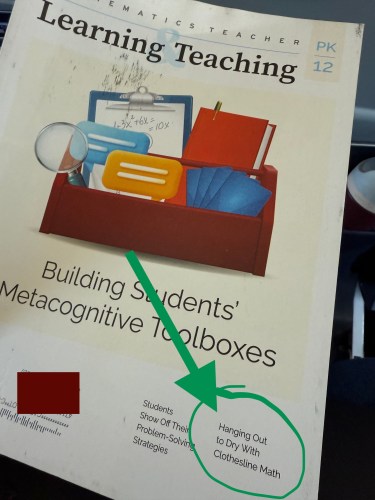

If you’d like to read the article for yourself….Click HERE
Until next time,
Kristen